
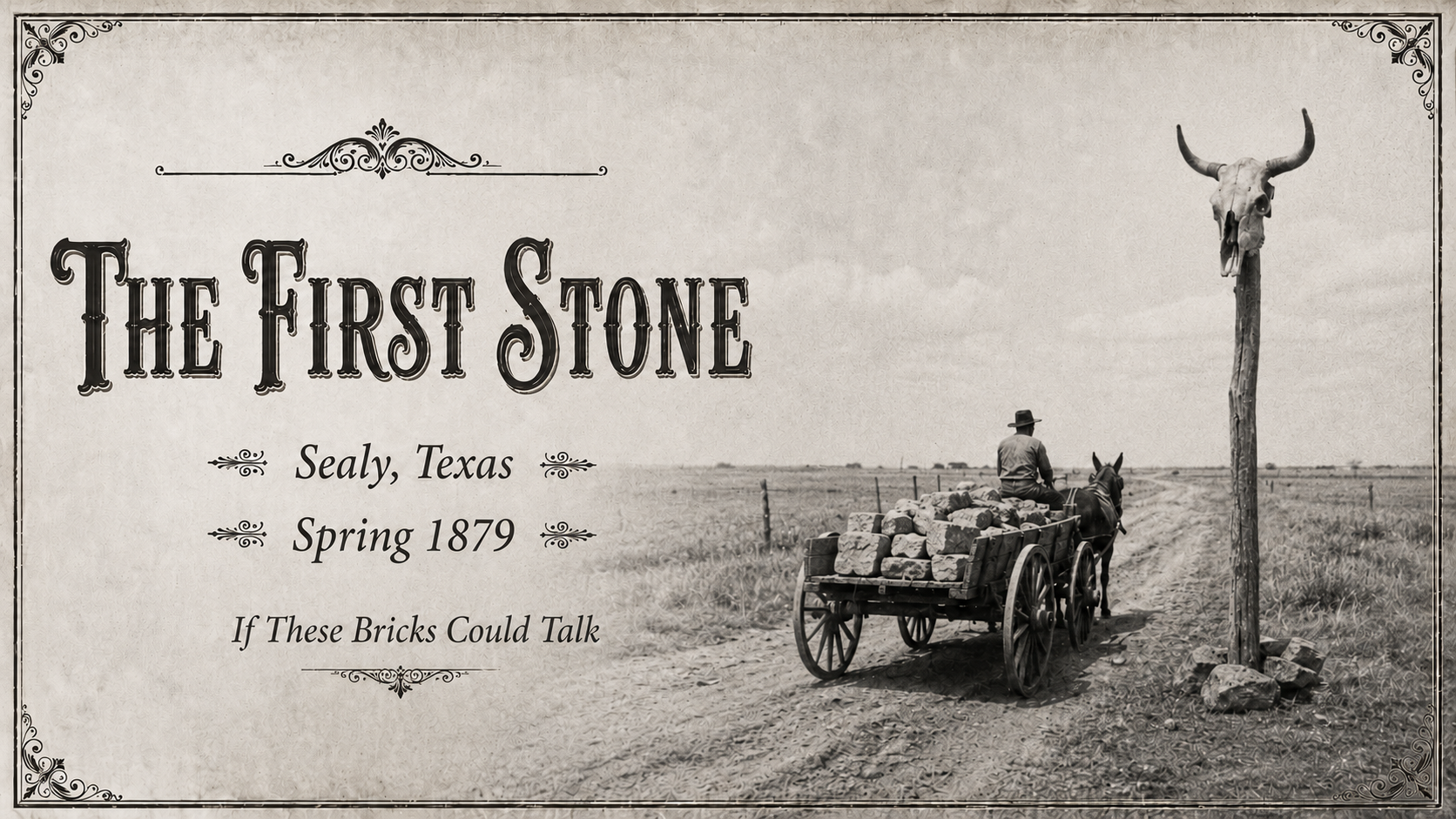
Click here to watch The First Stone
In the spring of 1879, the town of Sealy did not yet exist. The area that would become downtown was still open prairie, crossed by wagon roads and surrounded by established farms, ranches, and older Austin County communities. San Felipe de Austin, only a few miles away, had once served as one of the most important political and commercial centers of early Texas. By the late 1870s, however, a new form of transportation was changing where people lived, worked, and conducted business across the state. That change was the railroad.
The Gulf, Colorado and Santa Fe Railway had been chartered in 1873 by Galveston businessmen who wanted to establish a direct rail connection between the island city and the interior of Texas. Galveston was one of the state’s major ports, and an inland railroad would allow passengers, agricultural products, livestock, merchandise, machinery, lumber, mail, and other goods to move more efficiently between the coast and communities farther inland.
Construction of the railroad began in 1875, but building a rail line across the Texas coastal plain was an expensive and difficult undertaking. Survey crews had to determine the route, roadbeds had to be prepared, bridges constructed, timber brought in for ties, and iron rails laid mile after mile. Financial difficulties eventually threatened the project.
In April 1879, Galveston businessman George Sealy purchased the struggling railroad at foreclosure as trustee. Four days later, Sealy and his associates reorganized the company and continued the effort to extend the line northward. Sealy was already a prominent figure in Galveston banking, shipping, and business, but his involvement with the railroad would also permanently connect his name to a new town in Austin County.
As the railway advanced, the company acquired land south of San Felipe along its projected route and began laying out a townsite beside the tracks. Streets and lots could be drawn on a survey, but on the ground there was still very little to suggest that a town would soon stand there.
One of the best descriptions of those early days came years later from William I. Hill, who had seen the townsite as a child. Hill was nine years old in 1879. He remembered traveling to the new settlement with his older brother, J. H. Hill, who was eighteen at the time. The brothers hauled foundation stone by wagon from the Mill Creek area to the developing townsite. The stone was intended for the foundations of the first structures being erected near the railroad. Before wooden walls could be framed and buildings could rise, builders needed a solid base beneath them. Stone had to be obtained, loaded onto wagons, hauled over the rough country roads, unloaded, positioned, and leveled by hand.
For the Hill brothers, the trip from Mill Creek would have been slow work. A wagon carrying a heavy load of stone could travel only as quickly as the animals pulling it and the condition of the road allowed. During dry weather the wagon would have raised dust behind it, while rain could turn the route into mud and make the journey even more difficult. What William Hill remembered about the destination gives an especially clear picture of how undeveloped the townsite still was. He recalled a tall pole with an old steer’s head fastened to the top. Standing alone on the prairie, it served as a landmark at a time when there were few buildings or other recognizable features to guide someone arriving by wagon.
That unusual memory helps place Sealy’s beginning in perspective. The streets that would later become familiar parts of town were still being surveyed. The commercial district had not yet taken shape. The depot, businesses, homes, and other structures that would define the community were only beginning to appear. Yet the foundation stones being hauled from Mill Creek showed that the plans for the new town were becoming real.
There is no surviving record of what William and J. H. Hill may have talked about during those trips. The accompanying film uses a father-and-son relationship as a dramatic device to recreate the journey; however, Hill’s historical recollection identifies his companion as his older brother, J. H. Hill. The dialogue shown in the film is therefore an interpretation rather than a record of an actual conversation. What survives from Hill’s account is that he was nine years old, that he traveled to the new townsite with his brother, and that they hauled foundation stone from the Mill Creek area.
At the same time, railroad crews were continuing to push the Gulf, Colorado and Santa Fe line toward the townsite. The arrival of the railroad was important for much more than passenger travel. Rail transportation could transform the economy of an entire area. Farmers who had previously moved cotton and other crops long distances by wagon would have access to a nearby shipping point. Merchants could receive larger quantities of goods more quickly. Mail and newspapers could arrive more regularly. Families moving into the area could transport possessions and equipment more efficiently, and local producers could gain better access to distant markets. For a community such as Sealy, the railroad was not simply another service added to an existing town. The town was being created because the railroad was there.
On December 22, 1879, the railroad track was completed to the new townsite. The completion of the line marked a major turning point. Until then, Sealy had been a planned settlement beside an advancing railroad. Once the rails reached the site, it became part of a transportation system connected to Galveston and, as the Santa Fe continued expanding, to communities farther across Texas.
By January 1880, historical accounts indicate that a depot was in place and regular freight and passenger service had begun. Trains brought a new pattern of activity to what only months earlier had been open prairie. Passengers arrived and departed, freight was unloaded, mail moved through the community, and wagons carried goods between the railroad and the surrounding countryside.
The settlement was named Sealy in honor of George Sealy, whose leadership had helped preserve and continue the railroad project during its difficult period in 1879. The relationship between the town and the railroad was therefore present from the very beginning. Sealy developed where it did because the tracks passed through this part of Austin County, and the railroad provided the transportation and economic opportunities that encouraged people to settle there.
The transformation happened quickly. By August 1880, accounts reported that two passenger trains and two freight trains were passing through Sealy each day. The community would eventually become an important division point on the Santa Fe system, with railroad yards, a roundhouse, a wooden turntable, and machine shops. Those later developments would bring railroad employees, merchants, tradesmen, families, and new businesses into the growing settlement. Front Street would begin filling with stores and other establishments facing the railroad, and people whose names became closely connected with early Sealy history would arrive to take advantage of the opportunities the new town offered.
The story preserved in William Hill’s memory takes us back to the brief period before all of that growth, when Sealy was still more plan than town. His recollections provide details that railroad records, maps, and deeds cannot. Official documents can tell us when a railroad was chartered or when a track was completed. Surveys can show where streets and lots were planned. Railroad records can document stations, facilities, and train service. William Hill remembered what the place actually looked like.
Those stones represented something very simple but important. Before a town could have stores, hotels, churches, homes, or a busy commercial street, it first had to be built. The foundation stones hauled into the settlement in 1879 were among the materials used to turn a railroad company’s plans into something permanent. By the end of that year, the rails had reached the prairie and regular train service was close behind.
The foundation had been laid for the community that would grow around them.
Historical Note
The account of the Mill Creek foundation stone, the steer’s head mounted on a pole, and nine-year-old W. I. Hill traveling to the new Sealy townsite with his brother comes from Hill’s later recollections of the community’s beginning. The dialogue shown in the accompanying film is a dramatic interpretation and is not a surviving transcript of an actual conversation.
Historical railroad accounts confirm the reorganization of the Gulf, Colorado and Santa Fe Railway under George Sealy and his associates in 1879. Local chronology places completion of the railroad track to the Sealy townsite on December 22, 1879. By January 1880, a depot and regular freight and passenger service were operating, and by August 1880, two passenger trains and two freight trains were reportedly passing through Sealy each day.